Thursday, August 29, 2019


Saturday, August 17, 2019
New drug GVT progresses in research aimed at helping Gulf War Illness and other neurodegenerative diseases
(91outcomes.com - August 17, 2019) - A small pharmaceutical company has taken positive findings from a Gulf War Illness (GWI) treatment research pilot study and now working on the next steps to test it to verify that it may indeed help alleviate Gulf War Illness symptoms.
The original work on this formulation was funded through a Fiscal Year 2013 treatment study by the treatment-focused, veteran-driven Gulf War Illness Research Program (GWIRP) funded by Congress at the request of ill Gulf War veteran advocates and within the Congressionally Directed Medical Research Program (CDMRP).
The original work on this formulation was funded through a Fiscal Year 2013 treatment study by the treatment-focused, veteran-driven Gulf War Illness Research Program (GWIRP) funded by Congress at the request of ill Gulf War veteran advocates and within the Congressionally Directed Medical Research Program (CDMRP).
Saturday, August 10, 2019
I think I might have Gulf War Illness, what should I do?
(91outcomes.com) - If you think you might have Gulf War Illness (GWI), below are some basic suggested steps.
1) Read this overview about GWI:
Review this "state of the science" overview of Gulf War Illness (GWI): https://dx.doi.org/10.1016%2Fj.cortex.2015.08.022.
While it's fairly technical, skim and read the parts you can understand. You can also share this with your doctor or others.
Does it sound like you meet the following GWI criteria?
"The Kansas definition of GWI requires that cases have moderately severe or multiple chronic symptoms in at least three of six categories: fatigue/sleep problems, pain, neurological/cognitive/mood symptoms, respiratory complaints, gastrointestinal problems or skin symptoms (Steele, 2000) [lasting at least 6 months in duration]. Veterans who have severe psychiatric disorders or other medical conditions that might predict similar symptoms are excluded."
Most 1991 Gulf War veterans with GWI have had the symptoms for a very long time. Many had their symptoms begin during or soon after Gulf War deployment.
Wednesday, April 10, 2019
Funding Pre-Announcement - Gulf War Illness Treatment Research Grant opportunities
SOURCE: CDMRP, April 10, 2019
****
---------- Original message ---------
From: Communications@cdmrp.org <Communications@cdmrp.org>
Date: Wed, Apr 10, 2019 at 11:00 AM
Subject: JUST RELEASED! FY19 GWIRP, LRP, MRP and VRP Pre-Announcements
From: Communications@cdmrp.org <Communications@cdmrp.org>
Date: Wed, Apr 10, 2019 at 11:00 AM
Subject: JUST RELEASED! FY19 GWIRP, LRP, MRP and VRP Pre-Announcements
This e-mail is to notify the research community of recently released pre-announcements for the Gulf War Illness, Lupus, Melanoma, and Vision Research Programs managed by the Department of Defense office of Congressionally Directed Medical Research Programs (CDMRP) https://cdmrp.army.mil/pubs/
FY19 funding opportunities are anticipated for the following programs:
Gulf War Illness Research Program (GWIRP)
* Idea Award
* Idea Development Award
* Clinical Evaluation Award
* Therapeutic/Biomarker Trial Award
* Patient-Provider and Health Communications Award
* New Investigator Award
Lupus Research Program (LRP)
* Concept Award
* Impact Award
Melanoma Research Program (MRP)
* Concept Award
* Idea Award
* Team Science Award
* Translational Research Award
Vision Research Program (VRP)
* Focused Translational Team Science Award
* Investigator-Initiated Research Award
* Translational Research Award
Descriptions of each of the anticipated funding opportunities, eligibility, key mechanism elements, and funding can be found in the Program pre-announcement. FY19 pre-announcements can be found in the CDMRP home page features at https://cdmrp.army.mil . Subsequent notifications will be sent when the program announcements/funding opportunities are released.
Please do not respond directly to this message. To be added or removed from this email list please use the “Subscribe/unsubscribe” to program specific news and updates at https://ebrap.org.
………………………………………………………………………………
CDMRP also provides news and updates through Facebook, Twitter and YouTube.
Follow CDMRP on Facebook: https://www.facebook.com/
Follow CDMRP on Twitter: https://twitter.com/CDMRP
Subscribe to CDMRP on YouTube: http://www.youtube.com/CDMRP
Monday, March 18, 2019
GWIRP-funded study finds elevated rates of 7 chronic health conditions in Gulf War Veterans
(91outcomes.com – March 18, 2019) – Newly published results of a study of a large cohort of U.S. veterans of the 1991 Gulf War show a higher risk of numerous chronic health conditions, as compared to the general population. The excess risk was linked to reported exposure to Gulf War chemical weapons or an experimental drug troops were forced to take without informed consent.
Seven of nine surveyed conditions were shown to be at elevated risk among the veterans, including high blood pressure (HBP), high cholesterol, heart attack, diabetes, stroke, arthritis and chronic bronchitis.
For veterans reporting chemical weapons exposure, they showed higher risk of HBP, diabetes, arthritis, and chronic bronchitis. Those who reported taking pyridostigmine bromide (PB) nerve agent protective pills (NAPP’s), showed increased risk of heart attack and diabetes.
For veterans reporting chemical weapons exposure, they showed higher risk of HBP, diabetes, arthritis, and chronic bronchitis. Those who reported taking pyridostigmine bromide (PB) nerve agent protective pills (NAPP’s), showed increased risk of heart attack and diabetes.
“Gulf War veterans are showing accelerated aging patterns resulting in
Boston University: Gulf War Veterans “Aging” Faster
SOURCE: Boston University School of Public Health, Michelle Samuels reporting, March 18, 2019
https://www.bu.edu/sph/2019/03/18/gulf-war-veterans-aging-faster/
ARCHIVED ARTICLE:
https://www.bu.edu/sph/2019/03/18/gulf-war-veterans-aging-faster/
ARCHIVED ARTICLE:
Gulf War Veterans “Aging” Faster
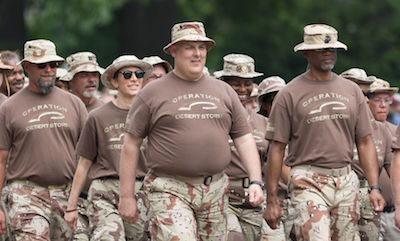
Veterans of the Gulf War march in the 2018 National Memorial Day Parade in Washington, DC.
About 200,000 veterans of the 1991 Gulf War continue to suffer from Gulf War Illness (GWI), a set of symptoms including chronic pain, fatigue, and memory impairment caused by sarin chemical warfare agent, pesticides, and pyridostigmine bromide (PB) pills meant to protect soldiers from nerve gas during deployment.
Decades later, these exposures may also be causing higher rates and earlier onset of
**URGENT ACTION ALERT** -- Gulf War Illness Treatment Research in Congress
Updated April 4, 2019

(91outcomes.com) -- For the last several years, there has been gradually building momentum to develop treatments for Gulf War Illness, a debilitating chronic health condition that science has shown to affect between one-fourth and one-third of the veterans from the 1991 Gulf War and that likely resulted from a combination of toxic exposures.
SPECIFIC ACTION NEEDED: The current targeted effort seeks co-signers in Congress before the fast approaching deadline for
Saturday, February 23, 2019
Public Draft of Common Data Elements Released; Aim is to Improve Gulf War Illness Treatment Research
(91outcomes.com) - Gulf War Illness treatment researchers have completed the first public draft of a project to increase the efficiency and effectiveness of GWI clinical research studies and treatment, increase data quality, facilitate data sharing and aggregation of information across studies, and help educate new clinical investigators.
Researchers, veterans, and advocates met for several months to define Common Data Elements (CDE's) useful for
Researchers, veterans, and advocates met for several months to define Common Data Elements (CDE's) useful for
Friday, February 22, 2019
Mouse model points to gastrointestinal neuroimmune disruption as contributing mechanism of Gulf War Illness
SOURCE: FEDERATION OF AMERICAN SOCIETIES FOR EXPERIMENTAL BIOLOGY
Press Release (via AAAS Eureka Alert!), https://www.eurekalert.org/pub_releases/2019-02/foas-tfj021219.php
ARCHIVED ARTICLE:
PUBLIC RELEASE:
The FASEB Journal: GI neuroimmune disruption contributes to Gulf War Illness
Mouse model points to gastrointestinal neuroimmune disruption as contributing mechanism of Gulf War Illness
Many Persian Gulf War veterans experience Gulf War Illness (GWI), a chronic condition with symptoms ranging from gastrointestinal to neurological. While exposure to the anti-nerve gas pyridostigmine bromide (PB) is linked to the development of GWI, the exact cause and mechanisms of the illness remain unclear. Recently, an animal study published in The FASEB Journal tested the hypothesis that exposure to PB contributes to the development of GWI by disrupting the neural and immune systems of the intestine.
A team of researchers
Friday, November 16, 2018
Gut bacterium deficiency linked to serious health issues -- is this related to recent progress finding treatments for Gulf War Illness
(91outcomes.com) - The Los Angeles Times reports that a new study suggests that sufficient levels of a critical gut bacterium may provide significant health benefits, while a deficiency is linked to serious health issues and an aging body.
The study by the
Gut chemical appears to be reduced in Gulf War Illness, may improve major GWI symptoms
(91outcomes.com) - A chemical important in the proper functioning of the gut appears in a new study to be problematically low in Gulf War Illness. The study showed that restoring it effectively improved key complications of Gulf War Illness (GWI), including systemic inflammation, chronic fatigue, GI disturbances, metabolic complications and weight gain.
The chemical, butyrate, is a
The chemical, butyrate, is a
Monday, August 6, 2018
In Memory of Joy "JoJo" Chavez
(91outcomes.com - August 6, 2018) -- It is with deep regret and profound sadness that we announce the passing of Joy "JoJo" Chavez. The Lord took JoJo home yesterday morning, August 5, 2018.
She was an activist and true warrior for ill Gulf War veterans. She led a focus group for multiple veterans who were ill. She was recognized by the Presidential Advisory Committee on Gulf War Veterans' Illnesses (PAC) in 1996 for providing the PAC with important information related to ill Gulf War veterans.
JoJo was a valued friend, and a loving wife and mother. She is survived by her husband, John Chavez -- formerly SSG Chavez, USAF, who served during the 1991 Gulf War, Operations Desert Shield and Desert Storm. Their experience with Gulf War Illness is described by former CIA analyst Patrick Eddington beginning in the opening paragraph of his 1997 book, "Gassed in the Gulf: The Inside Story of the Pentagon-CIA Cover-up of Gulf War Syndrome."
Most of all JoJo was like a fierce Mother Bear when it came to “her vets and their families” who were in need! We will all miss her!
Joy is survived by her husband, John; her son and a former Marine, Jonathon, and his wife Kellie, a registered nurse. Jonathon and Kellie are parents to Joy’s only grandchild, Everleigh Rose Lynn. JoJo loved all children but she adored her grand baby!
Very Respectfully,
Marguerite Knox
Wednesday, August 1, 2018
Funding Opportunity: Gulf War Illness Research Program - New Investigator Award
SOURCE: CDMRP Email, Aug. 1, 2018
---------- text of message ----------
From: Communications@cdmrp.org
Date: Wed, Aug 1, 2018 at 2:40 PM
Subject: JUST RELEASED! FY18 DoD GWIRP Program Announcement
---------- text of message ----------
From: Communications@cdmrp.org
Date: Wed, Aug 1, 2018 at 2:40 PM
Subject: JUST RELEASED! FY18 DoD GWIRP Program Announcement
This e-mail is to notify the research community of the recently released Fiscal Year 2018 (FY18) funding opportunity for the Department of Defense (DoD) Gulf War Illness Research Program managed by the office of Congressionally Directed Medical Research Programs (CDMRP).
Gulf War Illness Research Program
New Investigator Award
Detailed descriptions of the funding opportunity, evaluation criteria, and submission requirements can be found in the Program Announcements. The Program Announcements are available
Thursday, March 8, 2018
**URGENT ACTION ALERT** -- 5 Minutes to Help -- Gulf War Illness treatment research
ACTION NEEDED: Very specific --
SENATE: Ask your U.S. Senator to sign onto the "Baldwin 'Dear Colleague' Letter for Gulf War Illness treatment research funding" (FY 2019)
READ BELOW for more details before calling.
HOUSE: The House sign-on process has now closed. House Members may still submit their own letters to the House Defense Appropriations Subcommittee until COB March 19, 2018.
DEADLINE for sign on's:
SENATE: Wednesday, April 11, 2018
HOUSE: was Thursday, March 15, 2018
Current cosigners are listed at the end of this article.
**************************************
(91outcomes.com - Updated April 3, 2018) - Key members of Congress have launched a renewed bipartisan initiative to continue the Gulf War Illness Research Program (GWIRP) to develop treatments for Gulf War Illness.
The GWIRP is part of the Congressionally Directed Medical Research Program (CDMRP) administered by the U.S. Department of Defense under Congressional direction.
VA and scientific estimates show that Gulf War Illness affects between one-fourth and one-third of the veterans of the 1991 Gulf War. The consensus among Gulf War Illness medical researchers is increasingly clear: With the a concerted national effort, effective treatments can likely be found.
In the U.S. Senate, longstanding GWIRP champion U.S. Senate by Senator Tammy Baldwin (D-Wisconsin) again leads this year's push in the Senate continued funding for the unique, treatment-focused medical research program aimed at improving Gulf War veterans' health and lives.
This year’s effort was led in the House by Rep. Jack Bergman, LtGen, USMC (Ret.) (R-MI) and Rep. Gregorio Sablan (I-NMI), and supported by Rep. Phil Roe, M.D. and Rep. Tim Walz, former CSM, and USARNG (Ret.).
As a retired three-star Marine Corps general, Gen. Bergman, a veteran of the Vietnam War, is the highest ranking former military person ever to serve in Congress. Sablan represents the U.S. territory of the Northern Mariana Islands (NMI) and has been a strong supporter of the program for years, with deep concerns about the effects of Agent Orange in the NMI.
Dr. Roe is the Chairman of the full House Veterans' Affairs Committee, and Walz is the Ranking Member of the minority party on the Committee.
The GWIRP is a unique
federal program that continues to succeed in efforts to identify effective
treatments for Gulf War Illness (GWI), better understand GWI’s pathophysiology,
and identify objective biomarkers. The
GWIRP continues to demonstrate its effectiveness in its mission to improve the
health and lives of veterans debilitated and suffering from Gulf War Illness.
We need to ensure that these efforts continue for these veterans and for
current and future U.S. forces at risk of similar exposures and outcomes.
Maintaining funding for this
effective treatment-oriented program was recommended by the most recent (2014)
report of the Congressionally-mandated Research Advisory Committee on Gulf War
Veterans’ Illnesses (RAC). The Independent Budget Veterans Service
Organizations recommended that Congress “…provide sufficient funding to resume
robust research to identify effective treatments”.
·
Last year (calendar year 2017; Fiscal Year 2018), 83 Members of the House signed onto the letter.
·
Current HVAC Chairman
Roe and Ranking Member Walz were the bipartisan co-leads on the requests during the 114th Congress and last year and remain in
strong support this year.
·
A total of 13 HVAC members signed onto the letter last
year, including HVAC Chairman Roe and Ranking Member Walz,
Vice-Chairman Bilirakis, Subcommittee on Oversight and Investigations (O&I)
Chairman Bergman and Ranking Member Kuster, Subcommittee on
Health Ranking Member Brownley, Subcommittee on Disability & Memorial
Affairs (DAMA) Ranking Member Esty, and Subcommittee on Economic Opportunity
(EO) Ranking Member O’Rourke, and Members Peters, Pingree, Radewagen, Rice,
Sablan, and Takano.
Information below shows what you can do in just five minutes to support this critically important national effort to help our nation's Gulf War veterans.
******
STEP-BY STEP, HOW YOU CAN HELP IN JUST 5 MINUTES:
1. Find your federal representatives in Congress. You have one Representative in the House who represents the Congressional district in which you live and two U.S. Senators who represent your entire state.
- If you get their voicemail, leave a detailed voicemail with your specific request (below).
- [For example: "I'm among the one-third of Gulf War veterans of the 1991 Gulf War suffering from Gulf War Illness".
- Or, "I'm the wife/husband/son/daughter/parent of a Gulf War veteran suffering from Gulf War Illness."
- Or, "I'm one of many other veterans besides those who served in the Gulf War and I'm also suffering from a chronic multi-system illness like Gulf War Illness."
- Etc.
5. Provide the name of the "Dear Colleague" letter (there is no bill number -- this is a "Dear Colleague" request to get funding into a bill -- specifically the Fiscal Year 2019 Defense Appropriations Act):
- SENATE: The "Baldwin Dear Colleague Letter for Fiscal Year 2019 Gulf War Illness treatment research funding."
- HOUSE: The "Bergman-Sablan Dear Colleague Letter for Fiscal Year 2019 Gulf War Illness treatment research funding."
6. State that this is to continue funding for a successful, treatment-focused program and there were:
- HOUSE: 83 cosigners in the House last year (FY 2018) and 84 this year (FY 2019).
7. State the sign-on deadline (this is a hard deadline). The Senator/Congressman/Congresswoman will likely want to support the one-fourth to one-third of Gulf War veterans and others suffering from Gulf War Illness.
HOUSE:
HOUSE:
[Staff contacts, in case they ask are:
- HOUSE: Deadline: was Thursday, March 15, 2018. Staff Contacts for U.S. Rep. Jack Bergman (R-MI)--Mr. Gabe Hisem and for U.S. Rep. Gregorio Sablan (D-NMI)--Ms. Frances Diaz
- SENATE: Deadline: Wednesday, April 11, 2018. Staff Contacts for U.S. Sen. Tammy Baldwin (D-WI)--Mr. Jeremy Steslicki
8. Ask if you can email the staffer with a short one-pager about the program. This is very important. Then right away, email them the link to this document:
9. Ask that the staff person follow-up with you to let you know the Senator's or Congressman's/Congresswoman's decision.
10. Thank the staff person for their time.
AFTER YOUR CALL:
If they say they will sign on, post a comment below this post with the name of the Senator or Congressperson and the name of the staffer and that they will or will not sign on.
Follow-up in 2-3 days to find out the status, if you haven't heard back.
TIPS:
- Be polite
- Be pleasant
- Be urgent
- Be respectful
- Be convincing
- Be brief
- Be SPECIFIC with the REQUEST: Sign onto the "Baldwin" (U.S. SENATE) or "Bergman-Sablan" (U.S. HOUSE) "Dear Colleague Letter for Fiscal Year 2019 Gulf War Illness treatment research funding"
- Do not argue with, get angry with, or threaten the staffer in any way.
=======================
CURRENT COSIGNERS LIST: SEE BELOW
FREQUENTLY ASKED QUESTIONS (FAQ's)
WHAT IS THE GOAL?
The overall goal of the program is to find effective treatments for the officially estimated quarter-of-a million veterans of the 1991 Gulf War and others who are still suffering from the debilitating effects of Gulf War Illness.
These veterans were directly impacted by a veritable toxic soup of hazardous exposures during the short but intense war, and the best efforts our nation can provide to assist them.
WHAT CAN I DO TO HELP?
You can email, call, or electronically message your two U.S. Senators who represent you and your state in the U.S. Senate and your Congressman or Congresswoman who represents you in the U.S. House of Representatives.
See above for "10 quick and easy steps" to make your request.
Many Members of Congress have an option to submit your comments from a quick form right on their webpage.
WHO IS LEADING THIS FUNDING EFFORT IN CONGRESS?
HOUSE: In the U.S. House of Representatives, Rep. Jack Bergman, LTG, USMC (Ret.) (R-Michigan) and Rep. Gregorio Sablan (D-U.S. Territory of Northern Mariana Islands) are co-leading this effort. Both serve on the House Committee on Veterans' Affairs.
House Veterans Affairs Committee Chairman Rep. Phil Roe, M.D. (R-Tennessee) and Ranking Member Rep. Tim Walz (D-Minnesota) are backing this.
House Veterans Affairs Committee Chairman Rep. Phil Roe, M.D. (R-Tennessee) and Ranking Member Rep. Tim Walz (D-Minnesota) are backing this.
SENATE: In the United States Senate, U.S. Senator Tammy Baldwin (D-Wisconsin) is leading the bipartisan effort for the Senate.
This is a fully bipartisan effort.
AT WHAT LEVEL SHOULD THE FUNDING BE SUPPORTED, AND WHY?
The effort is to support the treatment-focused Gulf War Illness CDMRP. Their effort is calling for House Members to support this important program by signing onto a "Dear Colleague" letter requesting adequate continuation funding for this successful, unique, and important program.
WHY IS THIS PROGRAM NEEDED?
WHO SUPPORTS THIS PROGRAM?
Reports by the National Academy of Sciences’ Institute of Medicine (IOM)2 (pp. 10, 260-64) and the Congressionally-mandated VA Research Advisory Committee (RAC) on Gulf War Veterans’ Illnesses3 emphasize that “effective treatments, cures, and, it is hoped, preventions” for GWI can “likely be found,” “…through a concerted national effort and rigorous scientific input.” In addition, important discoveries made by the GWIRP may also help protect current and future U.S. military service members at risk of similar toxic exposures. (RAC 2014, pp. 1, 4, 5, 13, 78, 83; IOM 2010, pp. 10, 260-64.)
WHO SUPPORTS THIS PROGRAM?
The RAC, more than 50 FY15 Independent Budget Veterans’ Service Organizations (IBVSO’s), scientist GWIRP panelists,1,5 and numerous consumer reviewers serving with the GWIRP have expressed strong support for the GWIRP to improve the health and lives of veterans suffering from GWI.
The FY15 IBVSO’s said the GWI CDMRP, “has made great strides in the
short time it has been operating,” and the IBVSO’s (DAV, PVA, VFW, and 27 others) for the 115th Congress (2017-18) are asking Congress to “…provide sufficient funding to resume robust research to identify effective treatments...”
The program is supported by the nation's leading Veterans Service Organizations.
FY2019 VSO supporters include: Veterans of Foreign Wars, Veterans for Common Sense, National Gulf War Resource Center, National Vietnam and Gulf War Coalition, Burn Pits 360, Disabled American Veterans, Paralyzed Veterans of America, AMVETS, Vietnam Veterans of America, Jewish War Veterans of the USA, Fleet Reserve Association, Military Order of the Purple Heart, Enlisted Association of the National Guard of the United States, and the Air Force Association.
FY18 VSO supporters included: The American Legion; AMVETS; Burn Pits 360; Disabled American Veterans (DAV); Lung Cancer Alliance; National Gulf War Resource Center (NGWRC); National Vietnam & Gulf War Veterans Coalition; Paralyzed Veterans of America (PVA); Sergeant Sullivan Circle; Veterans for Common Sense (VCS); Veterans of Foreign Wars (VFW); and Vietnam Veterans of America (VVA).
FY17 VSO supporters included: the American Legion; AMVETS; Association of the U.S. Navy (AUSN); Burnpits360; Disabled American Veterans (DAV); Lung Cancer Alliance; National Gulf War Resource Center (NGWRC); National Vietnam & Gulf War Veterans Coalition; Paralyzed Veterans of America (PVA); Sergeant Sullivan Circle; Toxic Wounds Task Force; Veterans for Common Sense (VCS); Veterans of Foreign Wars (VFW); Vietnam Veterans of America (VVA).
FY2019 VSO supporters include: Veterans of Foreign Wars, Veterans for Common Sense, National Gulf War Resource Center, National Vietnam and Gulf War Coalition, Burn Pits 360, Disabled American Veterans, Paralyzed Veterans of America, AMVETS, Vietnam Veterans of America, Jewish War Veterans of the USA, Fleet Reserve Association, Military Order of the Purple Heart, Enlisted Association of the National Guard of the United States, and the Air Force Association.
FY18 VSO supporters included: The American Legion; AMVETS; Burn Pits 360; Disabled American Veterans (DAV); Lung Cancer Alliance; National Gulf War Resource Center (NGWRC); National Vietnam & Gulf War Veterans Coalition; Paralyzed Veterans of America (PVA); Sergeant Sullivan Circle; Veterans for Common Sense (VCS); Veterans of Foreign Wars (VFW); and Vietnam Veterans of America (VVA).
FY17 VSO supporters included: the American Legion; AMVETS; Association of the U.S. Navy (AUSN); Burnpits360; Disabled American Veterans (DAV); Lung Cancer Alliance; National Gulf War Resource Center (NGWRC); National Vietnam & Gulf War Veterans Coalition; Paralyzed Veterans of America (PVA); Sergeant Sullivan Circle; Toxic Wounds Task Force; Veterans for Common Sense (VCS); Veterans of Foreign Wars (VFW); Vietnam Veterans of America (VVA).
The FY15 Independent Budget Veterans Service Organizations (IBVSO’s, composed of AMVETS, DAV, PVA, VFW, and 53 other organizations that serve veterans) stated that the GWI CDMRP, “has made great strides in the short time it has been operating.” (pp. 126-27)
WHEN SHOULD I CALL MY SENATORS'/CONGRESSPERSON'S OFFICE?
Right away. The deadline is fast approaching. Typically, their offices need one or more days to secure approval to sign-on.
WHEN IS THE DEADLINE?
HOUSE: The sign-on deadline for Congresspersons in the U.S. House of Representatives to sign-on was Thursday, March 15, 2018.
SENATE: The sign-on deadline for Senators in the U.S. Senate is Wednesday, April 11, 2018.
SENATE: The sign-on deadline for Senators in the U.S. Senate is Wednesday, April 11, 2018.
*******
ADDITIONAL QUESTIONS
WHERE CAN I LEARN MORE ABOUT THE GULF WAR ILLNESS RESEARCH PROGRAM?
The Gulf War Illness Research Program (GWIRP), part of the Congressionally Directed Medical Research Program (CDMRP), a Congressionally directed activity funded under the U.S. Department of Defense, has a comprehensive website on the GWI program at: http://cdmrp.army.mil/gwirp . The GWIRP also publishes an overview of the program in its GWIRP program booklet.
The GWIRP also publishes an overview of what is known scientifically about Gulf War Illness: The Gulf War Illness Landscape .
The GWIRP also publishes an overview of what is known scientifically about Gulf War Illness: The Gulf War Illness Landscape .
Veterans for Common Sense (VCS), a leading national veterans' education and advocacy organization, has published the following two documents about the Gulf War Illness Research Program:
WHEN IS THE NEXT FUNDING AVAILABILITY FOR GULF WAR ILLNESS TREATMENT RESEARCH FUNDS?
Funding announcements are typically made in the late Spring of each year, but timing may vary quite a bit from year to year, depending upon Congressional appropriations.
WHAT IS RECENT RESEARCH SAYING ABOUT GULF WAR ILLNESS?
Recent research shows that chemical exposures are causally associated with Gulf War Illness. Psychiatric causes have been ruled out.
Another important advance for finding treatments for Gulf War Illness, funded by the GWIRP, was published in March 2017:
WHAT IS RECENT RESEARCH SAYING ABOUT GULF WAR ILLNESS?
Recent research shows that chemical exposures are causally associated with Gulf War Illness. Psychiatric causes have been ruled out.
This paper reviews the recent medical literature on the health of 1991 Gulf War veterans, focusing particularly on the central nervous system and on effects of Gulf War toxicant exposures:
Another important advance for finding treatments for Gulf War Illness, funded by the GWIRP, was published in March 2017:
Finally, this update shows all the recent research published findings from GWIRP-funded research since from about mid-2016 to March 2, 2018:
...and this update shows recent GWIRP successes:
WHO IS CURRENTLY COSIGNED ON THE LETTER?
SENATE: The Senators currently signed on (as of Tuesday, April 3, 2018) are:
Last
Name
First
Name
State
1
Baldwin
Tammy
WI
2
Merkley
Jeff
OR
3
Wyden
Ron
OR
4
Menendez
Robert
NJ
5
Van
Hollen
Chris
MD
6
Peters
Gary
MI
7
Hirono
Mazie
HI
8
Klobuchar
Amy
MN
9
Sanders
Bernie
VT
10
Markey
Edward
MA
HOUSE: The Members of the House who signed on for FY2019 (closing date Thursday, March 15, 2018) were:
Last Name
First Name
District
1
Bergman
Jack
MI-01
2
Bilirakis
Gus M.
FL-12
3
Bost
Mike
IL-12
4
Brown
Anthony G.
MD-04
5
Brownley
Julia
CA-26
6
Buchanan
Vern
FL-16
7
Bustos
Cheri
IL-17
8
Cárdenas
Tony
CA-29
9
Carson
Andre
IN-07
10
Chu
Judy
CA-27
11
Cicilline
David N.
RI-01
12
Clarke
Yvette D.
NY-09
13
Correa
J. Luis
CA-46
14
Crist
Charlie
FL-13
15
Cummings
Elijah E.
MD-07
16
Davis
Susan A.
CA-53
17
DeFazio
Peter A.
OR-04
18
DeGette
Diana
CO-01
19
Delaney
John K.
MD-06
20
DeLauro
Rosa L.
CT-03
21
DeSaulnier
Mark
CA-11
22
Dingell
Debbie
MI-12
23
Doggett
Lloyd
TX-35
24
Dunn
Neal P.
FL-02
25
Ellison
Keith
MN-05
26
Eshoo
Anna G.
CA-18
27
Esty
Elizabeth H.
CT-05
28
Frankel
Lois
FL-21
29
Gabbard
Tulsi
HI-02
30
Gallego
Ruben
AZ-07
31
González Colón
Jenniffer
PR-AL
32
Grijalva
Raúl M.
AZ-03
33
Hastings
Alcee L.
FL-20
34
Jackson Lee
Sheila
TX-18
35
Johnson
Bill
OH-06
36
Johnson, Jr.
Henry C. "Hank"
GA-04
37
Jones
Walter B.
NC-03
38
Katko
John
NY-24
39
Keating
William R.
MA-09
40
Kind
Ron
WI-03
41
Krishnamoorthi
Raja
IL-08
42
Kuster
Ann MacLane
NH-02
43
Larsen
Rick
WA-02
44
Lee
Barbara
CA-13
45
Lieu
Ted
CA-33
46
Lipinski
Daniel W.
IL-03
47
Loebsack
Dave
IA-02
48
Lowenthal
Alan
CA-47
49
Lynch
Stephen F.
MA-08
50
McGovern
James P.
MA-02
51
Moore
Gwen S.
WI-04
52
O'Rourke
Beto
TX -16
53
Payne, Jr.
Donald M.
NJ-10
54
Perlmutter
Ed
CO-07
55
Peters
Scott H.
CA-52
56
Peterson
Collin C.
MN-07
57
Pingree
Chellie
ME-01
58
Plaskett
Stacey E.
USVI-00
59
Poliquin
Bruce
ME-02
60
Polis
Jared
CO-02
61
Radewagen
Aumua Amata C.
AS-00
62
Rice
Kathleen M.
NY-04
63
Roe, M.D.
Phil
TN-01
64
Rosen
Jacky
NV-03
65
Ruiz
Raul
CA-36
66
Sablan
Gregorio Kilili Camacho
MP-00
67
Sanchez
Linda T.
CA-38
68
Schakowsky
Jan
IL-09
69
Shea-Porter
Carol
NH-01
70
Shrader
Kurt
OR-05
71
Sinema
Kyrsten
AZ-09
72
Sires
Albio
NJ-08
73
Soto
Darren
FL-09
74
Speier
Jackie
CA-14
75
Takano
Mark
CA-41
76
Veasey
Marc
TX-33
77
Vela
Filemon
TX-34
78
Walz
Tim
MN-01
79
Welch
Peter
VT-AL
80
Yarmuth
John A.
KY-03
81
Yoho, D.V.M.
Ted S.
FL-03
...and this update shows recent GWIRP successes:
WHO IS CURRENTLY COSIGNED ON THE LETTER?
SENATE: The Senators currently signed on (as of Tuesday, April 3, 2018) are:
|
|
Last
Name
|
First
Name
|
State
|
|
1
|
Baldwin
|
Tammy
|
WI
|
|
2
|
Merkley
|
Jeff
|
OR
|
|
3
|
Wyden
|
Ron
|
OR
|
|
4
|
Menendez
|
Robert
|
NJ
|
|
5
|
Van
Hollen
|
Chris
|
MD
|
|
6
|
Peters
|
Gary
|
MI
|
|
7
|
Hirono
|
Mazie
|
HI
|
|
8
|
Klobuchar
|
Amy
|
MN
|
|
9
|
Sanders
|
Bernie
|
VT
|
|
10
|
Markey
|
Edward
|
MA
|
HOUSE: The Members of the House who signed on for FY2019 (closing date Thursday, March 15, 2018) were:
Last Name
|
First Name
|
District
|
|
1
|
Bergman
|
Jack
|
MI-01
|
2
|
Bilirakis
|
Gus M.
|
FL-12
|
3
|
Bost
|
Mike
|
IL-12
|
4
|
Brown
|
Anthony G.
|
MD-04
|
5
|
Brownley
|
Julia
|
CA-26
|
6
|
Buchanan
|
Vern
|
FL-16
|
7
|
Bustos
|
Cheri
|
IL-17
|
8
|
Cárdenas
|
Tony
|
CA-29
|
9
|
Carson
|
Andre
|
IN-07
|
10
|
Chu
|
Judy
|
CA-27
|
11
|
Cicilline
|
David N.
|
RI-01
|
12
|
Clarke
|
Yvette D.
|
NY-09
|
13
|
Correa
|
J. Luis
|
CA-46
|
14
|
Crist
|
Charlie
|
FL-13
|
15
|
Cummings
|
Elijah E.
|
MD-07
|
16
|
Davis
|
Susan A.
|
CA-53
|
17
|
DeFazio
|
Peter A.
|
OR-04
|
18
|
DeGette
|
Diana
|
CO-01
|
19
|
Delaney
|
John K.
|
MD-06
|
20
|
DeLauro
|
Rosa L.
|
CT-03
|
21
|
DeSaulnier
|
Mark
|
CA-11
|
22
|
Dingell
|
Debbie
|
MI-12
|
23
|
Doggett
|
Lloyd
|
TX-35
|
24
|
Dunn
|
Neal P.
|
FL-02
|
25
|
Ellison
|
Keith
|
MN-05
|
26
|
Eshoo
|
Anna G.
|
CA-18
|
27
|
Esty
|
Elizabeth H.
|
CT-05
|
28
|
Frankel
|
Lois
|
FL-21
|
29
|
Gabbard
|
Tulsi
|
HI-02
|
30
|
Gallego
|
Ruben
|
AZ-07
|
31
|
González Colón
|
Jenniffer
|
PR-AL
|
32
|
Grijalva
|
Raúl M.
|
AZ-03
|
33
|
Hastings
|
Alcee L.
|
FL-20
|
34
|
Jackson Lee
|
Sheila
|
TX-18
|
35
|
Johnson
|
Bill
|
OH-06
|
36
|
Johnson, Jr.
|
Henry C. "Hank"
|
GA-04
|
37
|
Jones
|
Walter B.
|
NC-03
|
38
|
Katko
|
John
|
NY-24
|
39
|
Keating
|
William R.
|
MA-09
|
40
|
Kind
|
Ron
|
WI-03
|
41
|
Krishnamoorthi
|
Raja
|
IL-08
|
42
|
Kuster
|
Ann MacLane
|
NH-02
|
43
|
Larsen
|
Rick
|
WA-02
|
44
|
Lee
|
Barbara
|
CA-13
|
45
|
Lieu
|
Ted
|
CA-33
|
46
|
Lipinski
|
Daniel W.
|
IL-03
|
47
|
Loebsack
|
Dave
|
IA-02
|
48
|
Lowenthal
|
Alan
|
CA-47
|
49
|
Lynch
|
Stephen F.
|
MA-08
|
50
|
McGovern
|
James P.
|
MA-02
|
51
|
Moore
|
Gwen S.
|
WI-04
|
52
|
O'Rourke
|
Beto
|
TX -16
|
53
|
Payne, Jr.
|
Donald M.
|
NJ-10
|
54
|
Perlmutter
|
Ed
|
CO-07
|
55
|
Peters
|
Scott H.
|
CA-52
|
56
|
Peterson
|
Collin C.
|
MN-07
|
57
|
Pingree
|
Chellie
|
ME-01
|
58
|
Plaskett
|
Stacey E.
|
USVI-00
|
59
|
Poliquin
|
Bruce
|
ME-02
|
60
|
Polis
|
Jared
|
CO-02
|
61
|
Radewagen
|
Aumua Amata C.
|
AS-00
|
62
|
Rice
|
Kathleen M.
|
NY-04
|
63
|
Roe, M.D.
|
Phil
|
TN-01
|
64
|
Rosen
|
Jacky
|
NV-03
|
65
|
Ruiz
|
Raul
|
CA-36
|
66
|
Sablan
|
Gregorio Kilili Camacho
|
MP-00
|
67
|
Sanchez
|
Linda T.
|
CA-38
|
68
|
Schakowsky
|
Jan
|
IL-09
|
69
|
Shea-Porter
|
Carol
|
NH-01
|
70
|
Shrader
|
Kurt
|
OR-05
|
71
|
Sinema
|
Kyrsten
|
AZ-09
|
72
|
Sires
|
Albio
|
NJ-08
|
73
|
Soto
|
Darren
|
FL-09
|
74
|
Speier
|
Jackie
|
CA-14
|
75
|
Takano
|
Mark
|
CA-41
|
76
|
Veasey
|
Marc
|
TX-33
|
77
|
Vela
|
Filemon
|
TX-34
|
78
|
Walz
|
Tim
|
MN-01
|
79
|
Welch
|
Peter
|
VT-AL
|
80
|
Yarmuth
|
John A.
|
KY-03
|
81
|
Yoho, D.V.M.
|
Ted S.
|
FL-03
|
WHAT DOES THE "DEAR COLLEAGUE" LETTER ACTUALLY SAY?
*****
--Anthony Hardie, 91outcomes.com Author and Gulf War veteran advocate.
The text of the letter that Members of the House are signing onto is below. The Senate letter looks very similar:
Dear Chairman/Chairwoman xxx and Ranking Member xxx:Thank you for your interest in and continued support of the Gulf War Illness Research Program (GWIRP) within the Department of Defense (DoD) Congressionally Directed Medical Research Programs (CDMRP), including the $20 million appropriated for Fiscal year 2018 (FY2018). As your Subcommittee begins work on FY2019 DoD appropriations, we respectfully request adequate funding for the GWIRP.Since its inception, the GWIRP has demonstrated significant progress in developing treatments for Gulf War Illness (GWI). The positive news is that treatment research for veterans afflicted by GWI has increased considerably, a direct result of clear, treatment-focused congressional direction and stable appropriations for the GWIRP.Successive reports by the congressionally-mandated Research Advisory Committee on Gulf War Veterans’ Illnesses (RAC) and the National Academy of Sciences, Engineering, and Medicine (NASEM) have shown that:· Gulf War Illness is a physical condition — likely caused by toxic exposures — that affects as much as one-third of the nearly 700,000 veterans who served in the 1991 Persian Gulf War.· Debilitating symptoms typically include “some combination of widespread pain, headache, persistent problems with memory and thinking, fatigue, breathing problems, stomach and intestinal symptoms, and skin abnormalities.”· Studies also found elevated incidence of Lou Gehrig’s disease (ALS) among Gulf War veterans as well as significantly elevated rates of death due to brain cancer among those who were most exposed to the release of nerve gas by the destruction of the Khamisiyah Iraqi arms depot.These reports emphasize that “effective treatments, cures, and, it is hoped, preventions” for GWI can “likely be found,” “…through a concerted national effort and rigorous scientific input.” In addition, important discoveries made by the GWIRP may also help protect current and future U.S. military service members at risk of similar toxic exposures.The GWIRP has shown itself to be a model on how to conduct treatment-oriented research to address a challenging illness. By Congressional design, the GWIRP is narrowly focused on “improving the health and lives of veterans who have Gulf War Illness,” by funding “innovative Gulf War Illness research to identify effective treatments, improve definition and diagnosis, and better understand pathobiology and symptoms.”The GWIRP is making considerable progress where earlier research failed to seek evidence-based treatments. In the past year, publications of GWIRP-funded studies in peer-reviewed scientific journals have highlighted numerous advances toward the GWIRP’s triple goals aimed squarely at improving the health and lives of GWI veterans: better understanding GWI’s pathophysiology; identifying biomarkers of GWI; and developing treatments for GWIThe interest in the scientific community created by the landmark RAC and the NASEM reports, consistent Congressional support, effective GWIRP management, and scientific discoveries in related fields are making possible important advances towards GWIRP’s goals.Recognizing the program’s progress, the RAC report’s recommendations remain instructive: “Congress should maintain its funding to support the effective treatment-oriented [GWIRP].”This request is supported by the Veterans of Foreign Wars, Veterans for Common Sense, the National Gulf War Resource Center, National Vietnam and Gulf War Veterans Coalition, Sergeant Sullivan Circle, Burn Pits 360, Paralyzed Veterans of America, Vietnam Veterans of America, Military Order of the Purple Heart, Fleet Reserve Association, Jewish War Veterans of the U.S., Enlisted Association of the National Guard of the US, and Air Force Association.We respectfully request that you provide the necessary resources to continue this vital and effective program.Sincerely,xxxxx
*****
--Anthony Hardie, 91outcomes.com Author and Gulf War veteran advocate.
Subscribe to:
Posts (Atom)