Tuesday, February 18, 2014

DALLAS NEWS: After 42 years, Robert Haley still has a passion for tackling medical mysteries

SOURCE:  Dallas News, Scott Parks reporting, 2/15/2014
http://www.dallasnews.com/news/metro/20140215-after-42-years-robert-haley-still-has-a-passion-for-tackling-medical-mysteries.ece?nclick_check=1

ARCHIVED TEXT:

After 42 years, Robert Haley still has a passion for tackling medical mysteries

164
7
0
3
AA
David Woo/Staff Photographer
“I don’t get aghast,” Dr. Robert Haley says. “I look with wonder at the world.”
1of3Next Image
Look behind an epidemic and there’s a good chance you’ll find Dr. Robert Haley crunching numbers to find the causes and cures.
Most physicians advise patients how to avoid or treat illness based on “the medical literature.” Haley, the pre-eminent epidemiologist in North Texas, writes the literature.
His is not a household name. Most people will never know how his research has helped them.
Dallas billionaire Ross Perot Sr., who financed Haley’s groundbreaking research into the mysterious “Gulf War illnesses,” calls him “the guy who gets things done and seeks no recognition.”
In 2012, West Nile virus killed 20 Dallas County residents.
Afterward, Haley showed that a “vector index” could forecast the next major West Nile outbreak. The index, a mathematical equation, determines the point at which so many mosquitoes become infected that they begin spreading the virus to humans.
Using the index, public health officials could determine when they needed to spring into action, Haley said. Early intervention with chemical pesticides could prevent another West Nile epidemic. But only if politics doesn’t get in the way.
“The dilemma is whether our community will have the political will to conduct aerial spraying before the cases and deaths mount,” he said.
Haley, who is 68, has served as chief of epidemiology at UT Southwestern Medical Center since 1983. As a tenured professor, he is mostly insulated from prevailing political winds. He isn’t shy about using his medical degree for social action.
Last year, concerned about exacerbations of asthma and other lung ailments, Haley moved air quality in North Texas to the top of his agenda. He and other physicians lobbied state regulators to curb air pollution from three antiquated coal-fired plants that generate electricity.
Soot from those plants — along with exhaust fumes from cars and trucks — are making some people sick and killing others, Haley warned. So far, state regulators have declined to make the energy industry spend money to clean up the plants or shut them down.
“The power centers that are challenged by real scientific studies defend themselves,” Haley said. “I don’t hate them. We need those corporate types to go out and bring energy to our homes. Part of the beauty of a free society is that it’s a free-for-all.”
The teacher
The sun had just risen on a chilly Wednesday morning. The cavernous lecture classroom at UT Southwestern was mostly deserted.
Haley waited patiently at the front of the room as his accomplished medical students, dressed in scrubs and white lab coats, trickled in. They were about to hear a lecture on how medical knowledge progresses through clinical investigation.
As he began his PowerPoint presentation, Haley cut a rather unremarkable figure: balding, medium height, medium weight, dressed in khakis, a starched blue dress shirt, a brown belt and brown shoes.
His lecture was anything but buttoned-down. It might have been titled, “Don’t go with the flow.”
“The best medical study is one that refutes dogma,” he began. “That is how we progress.”
Doctors once believed that stress, spicy foods or just having a Type A personality caused stomach ulcers, he told his students.
“Then some wise guy comes up with conjecture that this is wrong. He hypothesizes that a bacteria called H pylori is the cause. And he battles it out with other scientists to find the truth. And it turns out that H pylori is a cause of ulcers. No one study ever proves anything.”
Haley, in a sense, is a revolutionary. He uses data to turn conventional wisdom on its head. Yet he calmly accepts that many people will continue to embrace conventional wisdom, even after facts disprove it — a realization that would horrify many other scientists.
“I don’t get aghast,” he said. “I look with wonder at the world.”
A lifesaving study
Haley’s most far-reaching achievement, a nationwide study on how to control hospital-acquired infections, came early in his career. It has undoubtedly saved thousands of hospital patients and workers from unnecessary illness, even death, over the last 30 years.
As a young epidemiologist at the U.S. Centers for Disease Control in Atlanta — now the U.S. Centers for Disease Control and Prevention — Haley designed and directed a decade-long study called SENIC, for Study on Efficacy of Nosocomial Infection Control. (Nosocomial is a medical term meaning acquired or occurring in a hospital.)
At the time, in the 1970s, most hospitals followed standardized infection-control procedures. They relied, to a large extent, on the good intentions of doctors, nurses and cleaning crews. Very few institutions tracked infection rates in various areas — operating suites, intensive care units, maternity wards. But new technology was making it easier to gather and analyze data with computers.
Haley’s study suggested that hospitals could do certain things to dramatically reduce the spread of disease: hire an infection control officer, develop software to produce regular “scorecards” on infection rates and feed the data back to doctors and nurses so they could improve patient care.
The “best practices” that sprang from his landmark CDC study created a movement that became a mandate. Medicare and the Joint Commission on Hospital Accreditation now require hospitals to meet standards that Haley and his team developed three decades ago.
“SENIC really gave a jump-start to infection control that put the United States in the lead worldwide,” said Dr. Robert P. Gaynes, who worked for Haley at CDC. “It remains a unique medical study. In my view, it made Bob’s career.”
After a decade in Atlanta, Haley came home to Dallas to join the UT Southwestern medical school faculty in 1983. Now, 42 years into his career, he has no desire to retire.
“I’ll probably work till I drop,” he said. “I’ve got the most interesting job in the world. As long as my brain power holds out, I have a lot to teach young researchers.”
Gulf War illness
Army Col. William J. Davis III, now 63 and retired, was a respected Special Forces officer during the Persian Gulf War in 1990-91.
Davis went to war fit and healthy. He returned with short-term memory loss, muscle pain and weakness, constant fevers and a sensitivity to light. At first, he thought he’d had a stroke.
Davis wasn’t alone. About 700,000 Americans were deployed in the first Gulf War. When 150,000 of them came home complaining of mysterious ailments, military doctors told them all the same story: It was post-traumatic stress.
“It’s very hard not being believed, being told it’s all in your head,” Davis said. “It’s hard to take.”
Ross Perot, an indefatigable supporter of the military, heard the stories about sick veterans living in misery with no hope of a real diagnosis or treatment.
“It was obvious that these men had been wounded,” Perot recalled in an interview with The Dallas Morning News. “I took it to Haley, and he agreed to do the research.”
Over the last 18 years, Haley and a team of researchers have amassed a body of medical evidence showing that exposure to chemicals used in the war — and not stress — was responsible for the symptoms troubling Davis and thousands of others. Finally, veterans had an answer that made sense.
“I never thought it would feel so good to find out how screwed up I am,” Davis said. “Robert has this amazing ability to cut through the crap. For almost 20 years, he has stayed the course and kept trying to find answers.”
U.S. Sen. Kay Bailey Hutchison of Texas joined the search for truth about Gulf War illness more than a decade ago. The Dallas Republican, who has since retired, engineered a five-year, $75 million congressional earmark for UT Southwestern to support Haley’s research into what happened to the veterans.
That didn’t sit well with bureaucrats in the U.S. Department of Veterans Affairs.
“When that money hit, the VA — the civil service guys — just hated me,” Haley recalled. “If Sen. Hutchison could send money to someone who was not a VA-approved investigator, then 49 other senators could do the same thing. They were very threatened.”
When he began his research, Haley neither accepted nor rejected the conventional wisdom that Gulf War veterans were suffering from post-traumatic stress.
But time and again, his tests on their brains and central nervous systems pointed to chemical exposure as the culprit. Haley found that some veterans had inhaled sarin, a nerve gas, when a munitions dump exploded in Iraq. Others were exposed to pesticides. Still others had received vaccines intended to protect them from nerve gas attacks.
The Gulf War was portrayed by its supporters as a perfect victory: Wham, bam and Iraqi dictator Saddam Hussein, who had invaded Kuwait, was sent packing back to Baghdad. By insisting on researching the physiological causes of Gulf War illness, Haley and his ilk threatened that made-for-TV image of a glorious, short and sweet triumph. In the doctor’s version of history, things hadn’t gone so well for the U.S. troops sent to fight the war.
In 2009, the Department of Veterans Affairs canceled Haley’s research contract — the one Hutchison had steered to UT Southwestern — because of what it alleged were “persistent noncompliance and numerous performance deficiencies.” Several years earlier, another government agency had cooked up allegations that Haley had violated ethical rules on medical research. There were warnings that not just Haley’s contract but all federal grants to UT Southwestern were at risk.
“To make a long story short,” Perot recalled, “the government called the medical school and threatened to stop all government funding. Dr. Haley and UT Southwestern were under tremendous pressure not to do the research. But they kept on.”
Eventually, the issues between Haley and the feds were resolved. And he is now a hero to Davis and other veterans.
“The first word that comes to mind is ‘courage,’” Davis said. “God only knows what would have happened if I had not met Dr. Haley.”
Oak Cliff roots
Haley’s father and grandfather were doctors. Two uncles were doctors. His three brothers are doctors. Two of his three children are doctors.
He is proud of his family’s accomplishments, but if there is any show-off in him, it’s not apparent in his lifestyle.
In his driveway sits a silver 2006 Toyota Camry with 100,000 miles on it. He and his wife, Stephanie, have been married for 45 years. Having raised three children, they’re now empty nesters rattling around in a 3,700-square-foot North Dallas home near Walnut Hill Lane and Boedeker.
Haley knows he could have earned much more money had he gone into private practice instead of scientific research.
“We do all right. How much money do you really need to live?” he said.
His roots run throughout Oak Cliff.
His father, Dr. Arvel Haley, returned from World War II and moved his family into a whitewashed wood-frame house near Jefferson Boulevard. Raven’s Pharmacy, where his dad’s patients filled their prescriptions, is still open. But almost everything else from the old neighborhood is gone.
When Haley was in grade school, the family lived at 225 N. Rosemont. He spent his high school years in a comfortable home at 940 Kessler Parkway in north Oak Cliff. He and his three brothers shared a large second-story room that looked like something from a college dorm. They used the backyard pool to teach other kids to swim.
The leafy neighborhood behind Methodist Hospital was known as “Pill Hill” because of all the doctors who lived there. His dad could walk to work. Haley became an Eagle Scout (Troop 20) and a member of the National Honor Society. He played guitar and banjo in a folk/bluegrass band called The Kinsmen.
“We won KBOX radio’s battle of the bands one year and actually cut a record,” he said. “We thought about turning professional, but didn’t.”
Haley made all-city as the quarterback for Sunset High School. He graduated in 1963 and enrolled in Southern Methodist University. He met Stephanie there and earned a bachelor’s degree in philosophy in 1967. Then he went to medical school.
After earning his medical degree from UT Southwestern in 1971, he worked at Parkland Memorial Hospital for a couple of years, then headed off to the CDC in Atlanta.
His pioneering work there on controlling hospital-acquired infections earned good reviews. In 1983, UT Southwestern invited Haley to return to Dallas to teach, conduct research and see patients. He and Stephanie decided that this was where they would raise a family.
“It just all came together,” Haley said.
He can still play the banjo but is now a self-described opera buff.
‘Check your work’
Dr. Paul Fischer didn’t have a clue about how to gather and analyze data for an epidemiological study. His specialty was internal medicine. His job was to see patients.
In 1991, Fischer noticed an abnormal rate of hepatitis C, a viral liver infection, among his patients. To him, it looked like an epidemic. He wasn’t sure what was causing it.
So he went to see Haley, who became his collaborator and mentor. They developed a 70-question patient survey to explore different variables.
Fischer gathered information from 600 patients and carefully entered the information into a database.
“Did you check your work?” Haley asked him.
“I’m very careful,” Fischer replied, a bit defensively.
“That’s great,” Haley said. “Now go back and check your work.”
Fischer found a 10 percent error rate in his data entries.
When it came time to write a software program to analyze the data, Fischer hoped Haley would do it. Instead, the mentor handed his apprentice a stack of programming manuals.
“So I learned how to write code,” Fischer said. “Very few internists know how to do that.”
Their study identified tattooing as the top cause of hepatitis C’s spread through Dallas in the 1990s. Intravenous drug use, heavy drinking and accidental needle sticks were known causes of hep C. The tattoo thing was new.
As Haley expected, other scientists began poking holes in the study, questioning its design and methodology.
“This did not faze Robert in the least,” Fischer said. “It bothered me a lot. But now, finally, this year the CDC has acknowledged tattoos as a factor.”
More than a decade later, Fischer uses the skills he learned from Haley to gather data on patients, enter it into customized software programs and analyze it quickly to diagnose and treat illnesses.
“I am living off Robert’s wisdom,” he said. “Every bit of what I do came from him because he made me learn to program. Thank God he is here for the benefit of the rest of us.”


AT A GLANCE: Dr. Robert W. Haley
Age: 68
Hometown: Dallas
Birth Place: Houston
Occupation: Epidemiologist and professor at UT Southwestern Medical Center, 1983 to present
Education: Bachelor’s degree, philosophy, Southern Methodist University, 1967; medical degree, UT Southwestern, 1971
Personal: Married to Stephanie Haley; three grown children

Self-portrait
Politically, I’m: Independent. I’ve supported Republicans and Democrats over the years.
Favorite movie: Casablanca or Gone with the Wind. (Can’t decide.)
Last book I read: Barbara Tuchman’s The Guns of August (for the 100th anniversary of the start of World War I).
Favorite food: My wife’s oatmeal lace cookies.
Aside from my family, my biggest accomplishment is: Research establishing the efficacy of infection surveillance and control programs … in hospitals.
Biggest regret: Quitting violin lessons at age 13 after six years. (My mother told me I would regret it, and she was right.)
The guests at my fantasy dinner would be: Mozart, Tolstoy, Niccolo Paganini, Ludwig Wittgenstein, William Osler, John Snow, Ignaz Semmelweiss, Don Meredith, Harold Jeskey and Donald Seldin.
The possession I value most is: My mother’s violin.
Hobbies: Opera fanatic. Violin practice master for two grandchildren.
Religion: Raised Methodist. Now a member of Preston Hollow Presbyterian Church.

Friday, January 17, 2014

Click to Support S. 1950, the Comprehensive Veterans Health and Benefits and Military Retirement Pay Restoration Act of 2014


Please take a moment to click on this link:


...to instantly send your 2 U.S. Senators and Congressman/Congresswoman your support for S. 1950, the Comprehensive Veterans Health and Benefits and Military Retirement Pay Restoration Act of 2014, which would provide:

*Fully restore military retirement cost-of-living adjustments that were outrageously reduced in the 2013 House-Senate budget agreement and the subsequent appropriations act.

*Extension of advance appropriations authority to more accounts (beyond health care) in Dept. of Veterans Affairs accounts to ensure that in any government shutdown environment in the future, veterans benefits payments would not be delayed or put in jeopardy.

*Authorization for in-state tuition rates at any public college or university for all student veterans using the new GI Bill, regardless of where they live.

*Honoring as veterans certain career Reserve members eligible for reserve retired pay.

*Authorization for Iraq and Afghanistan surviving spouses to the Post-9/11 GI Bill via the “Gunnery Sgt. John D. Fry Scholarship Program”.

*Retention of DIC by eligible widows who remarry at age 55.

*Improved care and services for veterans who who experienced military sexual trauma.

*Extension of VA health care enrollment opportunity for OIF-OEF veterans from 5 to 10 years.

*Renewal of the VOW to Hire Heroes Act veterans retraining assistance program.

*Requirement for more timely claims backlog reporting and new rules for VA reports on claims processing efforts, to increase transparency about the ongoing backlog problem.

*Improved treatment services for veterans

*An expansion of VA alternative medicine offerings and research, in response to concerns about overmedication of wounded veterans.

*A pilot project to expand dental care within the VA system.

*A two-year extension to the Veterans Training Assistance Program.

*An expansion of fertility services for service-injured veterans.

*Provide additional financial support to survivors of service members who die in the line of duty, as well as expanded access for them to GI Bill educational benefits.

*Solve a 2+-year stalemate in VA’s authority to lease facilities for health care treatment and other purposes.

..."These are but a few of the myriad provisions of this bill that would improve the lives, health, and prospects of veterans—especially the wounded, injured and ill—and their loved ones, if enacted into law." -DAV

***

SOURCES: DAV, Stars and Stripes, MOAA.

MOAA: Announces Support of S.1950, the Comprehensive Veterans Health and Benefits and Military Retirement Pay Restoration Act of 2014

SOURCE:  MOAA
http://www.prweb.com/releases/2014/01/prweb11501205.htm

ARCHIVED TEXT:

MOAA Announces Support of S.1950, the Comprehensive Veterans Health and Benefits and Military Retirement Pay Restoration Act of 2014

MOAA appreciates the inclusion of a provision in S. 1950 that repeals the unfair 1% COLA Cut of the earned pensions of working age military retirees established in the Balanced Budget Act and a number of other major MOAA priorities for veterans the legislation addresses.

  • Share on TwitterShare on FacebookShare on Google+Share on LinkedInEmail a friend
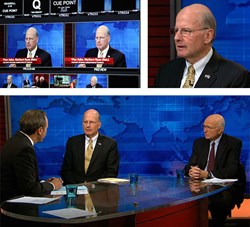
Defending Military Compensation MOAA President Vice Adm. Norb Ryan, Jr, USN (Ret) appeared on the PBS NewsHour program on January 2nd to discuss proposed changes to military compensation. (images by Mike Fritz/PBS NewsHour)
This legislation, based primarily on the bi-partisan Senate Veterans Benefits Omnibus, S. 944, offers comprehensive and much needed solutions for our returning warriors, veterans, survivors and family members,” MOAA President Vice Adm Norb Ryan said.
Alexandria, VA (PRWEB) January 17, 2014
Military Officers Association of America (MOAA)announces its support of the Veterans Health and Benefits Improvement Act, S.1950, the Comprehensive Veterans Health and Benefits and Military Retirement Pay Restoration Act of 2014.
“This legislation, based primarily on the bi-partisan Senate Veterans Benefits Omnibus, S. 944, offers comprehensive and much needed solutions for our returning warriors, veterans, survivors and family members,” MOAA President Vice Adm Norb Ryan said.
“MOAA deeply appreciates the inclusion of a provision in S. 1950 that repeals the unfair 1% COLA Cut of the earned pensions of working age military retirees established in the Balanced Budget Act,” he added.
The legislation also addresses a number of major MOAA priorities for veterans including: 
  • Extension of advance appropriations authority to more accounts (beyond health care) in Dept. of Veterans Affairs accounts
  • Authorization for in-state tuition rates at public colleges for all student veterans using the new GI Bill
  • Honoring as veterans certain career Reserve members eligible for reserve retired pay
  • Authorization for Iraq and Afghanistan surviving spouses to the Post-9/11 GI Bill via the “Gunnery Sgt. John D. Fry Scholarship Program”
  • Retention of DIC by eligible widows who remarry at age 55
  • Improved care and services for veterans who were sexually assaulted in military service
  • Extension of VA health care enrollment opportunity for OIF-OEF veterans from 5 to 10 years
  • Renewal of the VOW to Hire Heroes Act veterans retraining assistance program
  • Requirement for more timely claims backlog reporting
“These and other measures provide a strong foundation for our nation’s veterans after more than a dozen years of war in Iraq and Afghanistan,” Ryan stated.
“MOAA is very appreciative of the growing support in both chambers to repeal the grossly unfair COLA cut on earned military retirees’ pensions. The means of accomplishing that objective is up to leaders in both parties and we strongly support a bi-partisan solution as soon as possible to restore the full pensions of those who have dearly earned them in service to the nation,” Ryan concluded.
About MOAA:
Military Officers Association of America (MOAA) is the nation’s largest officers association with more than 380,000 members from every branch of service, including active duty, retired, National Guard, Reserve, and former officers and their families and survivors. MOAA is a nonprofit and politically nonpartisan organization and an influential force in promoting a strong national defense. MOAA represents the interests of service members and their families in every stage of their lives and careers, and for those who are not eligible to join MOAA, Voices for America’s Troops is a
nonprofit MOAA affiliate that supports a strong national defense. For more information, visit http://www.moaa.org orhttp://www.voicesfortroops.org/.
Members of the news media who wish to be added to our media distribution list for MOAA news releases, please contact requestnews@moaa.org. Visit MOAA’s Multimedia & Press Room at http://www.moaa.org/media/default.htm.
Share on TwitterShare on FacebookShare on Google+Share on LinkedInEmail a friend

STARS AND STRIPES: S. 1950 covers wide range of veterans issues, including repeal of COLA cuts for retirees

SOURCE:  Stars and Stripes (Leo Shane reporting)
http://www.stripes.com/bill-covers-wide-range-of-veterans-issues-including-repeal-of-cola-cuts-for-retirees-1.262662


ARCHIVED TEXT:

Bill covers wide range of veterans issues, including repeal of COLA cuts for retirees

WASHINGTON -- Congress could go from passing no major veterans legislation this session to passing every idea at once.
Senate Veterans Affairs Committee Chairman Bernie Sanders, I-Vt., this week introduced a wide-ranging package of veterans legislation, covering changes to the GI Bill, survivors’ benefits, advanced appropriations for the Department of Veterans Affairs and fertility treatments for wounded veterans.
In remarks Thursday, Sanders called the measure “the product of a year of bipartisan work” and maintains it “addresses virtually every single issue the veterans community has been concerned about.”
Even the bill’s title is lengthy: the Comprehensive Veterans Health and Benefit and Military Retirement Pay Restoration Act of 2014.
Senate Majority Leader Harry Reid, D-Nev., has moved to advance the legislation after next week’s congressional recess.
But its prospects for passage remain murky, largely due to the inclusion of a repeal of military retirement cost-of-living cuts passed in the recent budget deal.
The cut – a 1 percent reduction in the annual COLA adjustment for military retirees under 62 -- has rankled veterans advocates and drawn promises of repeal from both sides of the aisle.
But lawmakers have not come to any consensus on how to offset about $6 billion in savings from the cut. Sanders’ bill doesn’t spell out where the money would come from either. That’s expected to be clarified when the measure comes to the Senate floor for consideration.
Republicans in both chambers have resisted efforts to absorb more spending without equal savings. But they have also supported a number of provisions in Sanders’ massive veterans bill, meaning it still could move through both chambers in some form.
Veterans groups have offered support for most of the provisions in the bill, but were still going through the details Friday before offering a public endorsement.
Among those items:
  • New rules for VA reports on claims processing efforts, to increase transparency about the ongoing backlog problem.
  • In-state tuition at any public university for all veterans using GI Bill benefits, regardless where they live.
  • Improved treatment services for veterans who experienced military sexual trauma.
  • An expansion of VA alternative medicine offerings and research, in response to concerns about overmedication of wounded veterans.
  • A pilot project to expand dental care within the VA system.
  • A two-year extension to the Veterans Training Assistance Program.
  • An expansion of fertility services for service-injured veterans.
The House and Senate return to work Jan. 27.

Tuesday, January 14, 2014

VICTORY FOR GULF WAR VETERANS: Congress Says Yes, Will Fund Gulf War Illness CDMRP for Another Year


Written by Anthony Hardie


(91outcomes.com) - As the dust settled today on Capitol Hill, the news emerging from the budget deal conference committee is favorable for ill Gulf War veterans -- Congress has agreed to Gulf War veterans' strenuous requests and will continue the treatment-focused Gulf War Illness Congressionally Directed Medical Research Program (CDMRP) next year.


Just as it is every year, this year was a challenge for ill Gulf War veterans and their advocates to keep the program alive and funded at a level where it can be effective.  The program is well-liked by many Gulf War veterans, including those who have participated in cutting-edge research studies funded through the program and consumer reviewers who help decide which projects get funded.  


In the House, this year's effort to keep the Gulf War Illness CDMRP alive was championed by Rep. Mike Michaud (D-ME) and Rep. Phil Roe (R-TN).  Michaud, the ranking minority member of the House Veterans' Affairs Committee, and Roe, a medical doctor, were integral to this year's successful funding effort, which had been making its way through Congress for most of the last year.  

Along with continued public support from House Veterans' Affairs Committee (HVAC) Chairman Rep. Jeff Miller (R-FL), Michaud's lead helped pave the way to a record level of support this year in the House.  They were aided in large part by the efforts of a growing resurgence of Gulf War veteran grassroots advocates, many frustrated with VA's research failures but encouraged by the CDMRP's apparent progress.

Other leading House Veterans' Affairs supporters included Subcommittee on Oversight and Investigations (HVAC-O&I) Chair Rep. Mike Coffman (R-CO) and Ranking Member Rep. Ann Kirkpatrick (D-AZ), and Subcommittee on Economic Opportunity (HVAC-EO) Ranking Member Rep. Mark Takano (D-CA).


In the Senate, an effort led by Veterans' Affairs Committee Chairman Sen. Bernie Sanders (I-VT), a longstanding champion of the program and of Gulf War veterans, helped demonstrate the Senate's continued support.  The conference committee, led by Sen. Barbara Mikulski (D-MD) and Rep. Hal Rogers (R-KY) and nearly 50 members of the House and Senate, forged the final deal.  


The Gulf War Illness Research Program (GWIRP) will be funded at $20 million for Fiscal Year 2014, the same level as it was funded for this year, and a dramatic increase from its initial funding level of $5 million when it was begun just seven years ago.  While this year's funding was reduced significantly by mandated sequester cuts, it remains unclear what impact the sequester might have on next year's funding. 


At the same time, the U.S. Department of Veterans Affairs (VA) has remained under sustained criticism for the mishandling of its own Gulf War research program, which in over two decades and hundreds of millions of dollars spent has failed to develop a single effective treatment for Gulf War Illness.  In 2012, the federal panel (RAC) tasked with reviewing federal Gulf War research efforts issued a "no confidence" report regarding VA's Gulf War Illness research efforts.  


And last March, a top VA researcher-turned-whistleblower exposed a wide scale research coverup related to Gulf War Illness and burn pit exposures during the Iraq and Afghanistan Wars.  In June, two of the three Gulf War veterans on the panel resigned in protest to try to bring public attention to VA's failure to heed its own expert advisory panel.  To date, it remains unclear what action VA has taken to correct the many serious issues identified, if any.  


Researchers funded by the Gulf War Illness CDMRP presented their findings at a public meeting of the RAC panel last week included Dr. Nancy Klimas, Dr. Fiona Crawford, and Dr. Gordon Broderick.  Many of the Gulf War veterans attending the meeting by teleconference expressed optimism regarding the researchers' presentations.  


Gulf War Illness, a chronic multi-symptom disease believed to have been induced by wartime toxic exposures  along with a possible genetic component, affects roughly one-third of the 697,000 veterans of the 1991 Gulf War.  


***

For the actual appropriations language in the Joint Ombibus, see the FY14 DoD Appropriations portion at the link that follows.  The CDMRP funding provisions are at page 279 of the PDF.  

http://docs.house.gov/billsthisweek/20140113/113-HR3547-JSOM-C.pdf


Saturday, January 11, 2014

AP: VA Under Fire for Proposed Disability Filing Rule

SOURCE:  Associated Press (AP), Kevin Freking reporting
http://abcnews.go.com/Politics/wireStory/va-fire-proposed-disability-filing-rule-21497538


ARCHIVED ARTICLE:

VA Under Fire for Proposed Disability Filing Rule

For veterans seeking disability compensation, the application process is supposed to be so easy that a handwritten note on a napkin will initiate a claim or an appeal.
An Obama administration proposal would change that, and veterans groups are sounding the alarm.
The Department of Veterans Affairs says the many ways that requests for disability compensation arrive actually hamper its ability to administer benefits, and contribute to a claims backlog that has about 400,000 veterans waiting more than 125 days for a decision.
At times, workers spend so much time trying to figuring out what's being claimed and trading letters with applicants that it's slowing down decisions for everyone.
The VA's solution would require veterans to use a standard form when they file for disability compensation or appeal a decision, and the agency would throw in some incentives for those who use a computer.
The response to the proposed rule from the nation's major veterans groups?
"Draconian" and "heavy-handed," said the Veterans of Foreign Wars.
"A seismic change" that will "poison" the disability claims process, according to the American Legion.
"The most serious, egregious attack on a veteran-friendly disability claim system in VA history," contended the law firm of Bergmann & Moore, which specializes in pursuing disability claims.
The critiques recently submitted in response to the proposed regulation point to one of the sharpest policy disagreements that veteran groups have had with the administration.
Both camps generally have agreed on the need to transform how disability claims are managed; namely, the need to move to a computer system instead of relying on paper records to track a veteran's injuries, illnesses and service.
So far, the burden has been on the VA to transform. The proposal would place more of the burden on the veteran.
"VA believes that using a standard form is a minimal burden to place on claimants," the proposed rule states.
But for veterans, a major advantage of the current system is that once the VA makes its decision, benefits generally accrue back to when a veteran first initiated his or her claim, usually months and sometimes years earlier.
Submitting what are referred to as "informal claims" has become a standard practice for veterans because it locks in the effective date of their claim even as they gather supporting evidence such as military records and doctor's exams for the more formal application. Then, if the application is approved, the veteran often ends up getting a sizable lump-sum payment in addition to a monthly award.
Under the proposal, the first communication from a veteran may not trigger anything. Those veterans who put their claims in writing would have to completely fill out a standard form, and the clock that determines how far back the government will pay, won't begin ticking until the VA receives the successfully completed form.
The veterans groups say it's perfectly reasonable for the VA to use a standard form to enhance efficiency. But they worry that the time it takes to gather records and successfully complete the standard form could lead to substantially less money for veterans. They worry that the omission of a single entry could take months to resolve.
"A combat veteran of two tours in Iraq is defeated by a bureaucratic requirement to fill in all the boxes of a claim form," said the VFW's William Bradshaw in the organization's formal response.
They argue that veterans who are the most vulnerable — the homeless, those with traumatic brain injury and those with a limited education — would have the most trouble meeting the new standard.
The VA is trying to get more veterans to file disability claims electronically, so it will maintain a more relaxed standard for those who use its computer system. Even if the form is incomplete, the veteran will have a full year to finish it, and the VA still will consider the initial unfinished submission as the starting date for when benefits accrue.
But the veterans groups oppose that approach. They said that such favorable treatment for computer users ignores that millions of veterans, particularly the elderly, don't have computers or ready access to the Internet.
The VA said that veterans who don't have a computer can go to the closest VA facility to get help. It said numerous veteran organizations can also assist in filing claims electronically.
The VA said it has no fixed timeline for issuing a final rule. If the VA goes ahead with the regulation, it would take effect 30 days after its publication in the Federal Register.

Friday, January 10, 2014

DAVID WINNETT: "A Prayer for the Falling Gulf Warrior"

The following is a poem by David Winnett, a retired Marine Corps Captain and service-disabled veteran of the 1991 Gulf War who now lives in Texas.  He serves on the Integration Panel of the Gulf War Illness Congressionally Directed Medical Research Program (CDMRP). 


***


"A Prayer for the Falling Gulf Warrior"

He stands six foot three; she's not much more than five foot or so,
They've got everything in common,
And many other traits where they share no resemblance at all, from their head to their toes,
But what sets them apart yet makes them as one,
They're America's warriors;
America's daughter, America's son,
In a brief few words you could simply call them a couple of rough and tumble sons of guns,
They once dared you to a race, and beat you every time,
If you pointed them to a mountain that had never been topped, they'd plant Old Glory on its peak, at the end of their climb,
You'd give em a mission with impossible odds,
They'd get it done, and in no time be back asking you for another, a more challenging one,
Without reservation, hesitation or second thought, they're the best of America, the absolute cream of the crop,
But as much as they're appreciated while in uniform, it's so sad that far too often when these warriors come home,
Americans soon forget what they've done for freedom, very often in a deadly combat zone,
The rigors of combat cannot be put into words, or expressed with an appropriate level of accuracy that would allow the listener to see,
Unseen are the gore and horror that the warrior eye has viewed so very graphic and close,
Unappreciated goes the lasting emotional pain of seeing a fellow warrior die, often right here at home, a friend that the warrior loved much more than most,
Blind are Americans to the illnesses that live deep in the tissue of many otherwise healthy looking young men,
It's so sadly easy to turn the other way after telling the warrior to keep a stiff upper lip and hold up his chin,
"Don't worry" they say, "It's all in your head", "Move on with your life, otherwise your negative outlook is sooner or later going to kill you dead",
What they don't understand about the woman and the man, the warriors who demonstrated unequaled acts of bravery in a very hostile land,
Are the horrible man made toxins and various wares of modern war, the kinds of things the world has never seen on the battlefield before,
For all intents and purposes these warriors are walking dead,
What's painfully true now without any shadow of a doubt,
They're god damned right, it's all in our heads!  Their cluelessness makes me want to scream and shout!
As we slowly pass away at such a tragic young age, the VA doesn't care to take roll call to see who's alive or who among us are dead,
They'd just as soon continue to paint us all as maligerers, lazy old Veterans who just want a monthly check, a high def TV, and a nice cozy bed,
They tell the media that we're just the "Entitlement Crowd",
They believe we're void of morals, and that we're just a bunch of fakers who whine and moan too loud,
More that a quarter million Gulf Warriors are deathly ill,
We've buried thousands of our dead in countless cemeteries on countless hills,
Yet the attitude we still see in government is apathetic at best,
These clueless bastards - I'll let you fill in the rest ______,
So the VA sets up a committee for appearances sake,
Masters so they think in the realm of PR,
Telling lie after lie has sadly brought them this far,
They study us in graphs and flow charts all day long,
Then at night they sit casually in a swanky DC bar and grill, and talk about what to do, over a juicy ribeye steak and a glass of wine that's perfectly chilled,
And for twenty years and three this circus goes on, 
They bring their act and their clowns back to town; rain, snow, sleet or hail, as often as their per diem and travel pay checks arrive on time in the mail,
But for the sick Veterans this endless talk with very little action has become unbearably stale,
Once in a while a few of their committee members get out of line,
By daring to speak frankly, to speak their candid mind,
That's when the thought police arrive swiftly from the very top floor,
Then comes the boot in the ass; a thankless kick out the back alley door,
Daring to respectfully question the motives of the man on the top floor is a sure fire recipe that you won't be serving Veterans any more,
So shame on the VA Secretary and his morally bankrupt "Yes man" goons,
For shaming and dismissing the sacrifices of hundreds of thousands of men and women who once valiant served in harms way,
Only to be abandoned and publicly scorned to this very day,
We Veterans pray together nightly that justice will one day prevail,
And that those who disenfranchised us will pay dearly for their cruelty and spite,
That karma will visit with each of them with unmerciful might,
We pray that God will intervene and help Gulf War Veterans to prevail in this, our final and most brutal of fights.

David K. Winnett, Jr. 

CAPTAIN, USMC (Ret.)

KEITH NORDENG: What the VA Secretary Must Do to Help Ill Gulf War Veterans

The article below was submitted by Keith Nordeng, a service-connected Gulf War veteran from Harrisburg, Penn.  

***

I first would like to thank those who have served for so many years on the service of the Gulf War Vet on the Research Advisory Committee.

My name is Keith Nordeng. I’m only one of a multitude of ill veterans that had served in the Gulf region during 1990 to 1991. My voice is but one, but hopefully echoes for all of my fellow brothers and sisters that had served in the Persian Gulf theater of operations.

We as a group suffer from a myriad amount of physical problems ranging from cancers to pre-Alzheimer’s like symptoms. We advocate for ourselves daily in hopes that a few primary care physicians’ will realize that we do suffer from real physical injuries due to our service in the Gulf.

I for one have asked many physicians including those in the offices of environmental exposures in 3 hospitals located within VISN 4 of their knowledge of Gulf War Illness. Some of the replies have been “Your to old to have served in Iraq or Afghanistan”, Or you can take the Gulf War Exam as that is all that is offered. When I spoke to the Director of Environmental Exposures at the Philadelphia VAMC about the pocket guide to Gulf War Illnesses, that physicians are supposed to carry, her reply was that she ordered them in Jan 2012 but had never received the cards. This incident was in July 2013. My personal physician went through a 1 hour seminar conducted at the Coatesville VAMC on Gulf War Illness but she had thrown the card in a cabinet and she couldn’t find it anymore..

We know we will never know what specifically caused Gulf War Illness within our lifetime or any other lifetime as there are to many variables that have to be reproduced. Nor will there ever be a magic pill in the treatment due to its extensive symptoms which aren’t confined to CFS, IBS, Fibro or the other unexplained illnesses presented in the presumptive, which the Sec of VA has stated in the federal register of April 11, 2011 that there will be no new presumptive issued for Gulf War Illness.
With the research on Gulf War illness there shows a definite medical problem within the Gulf War veterans. WE ARE SICK. Granted there will never be a magic cure all, we do hope that there will be a better understanding of the illness in the near future as we are in deed in the last hour and minutes of the fight.

This will only happen from very strong, dynamic leadership from within VA. We the veteran demand from the Veterans Administration action on its part to improve quality of health with special emphasis on direct treatments of the Gulf War veteran using the recommendations arrived at from the Research Advisory Committee. This can only begin with the Secretary of the VA down through to include the middle entrenched beaurocrats to the local primary care physicians. 

I would also ask that the Gulf War veterans support the petition to keep a strong and dynamic leader such as Mr. Binns on as the Chairman of the Research Advisory Committee, for he has shown the leadership qualities that are and have been lacking in the fight for the Gulf War veteran from within and out of the Veterans Affairs.

I would like to remind the VA that the system is for the veteran imparted to the veteran through Congressional enactment and that it is answerable to the veteran and all citizens of this great nation. 

I now challenge all that are within the VA to do what is right and provide the veterans of the Gulf War and all other veterans of all era’s with the modern health care that we the Gulf War Veteran have earned and deserve.

WE served our nation!

-Keith Nordeng